
- Overview
- The three options
- Practical
- Verdict

Sales Lead, TimelinesAI·August 13, 2026·5 min read
Overview
What's actually at stake if you pick the wrong number type?
Losing an afternoon. WhatsApp registration has one hard gate: it sends a verification code by SMS (or a voice call, on some flows) to the number you're registering, and the number has to be able to receive it. That's the whole test. Pick a number that can't clear that gate — a data-only eSIM, a softphone extension your CRM calls a "virtual number" — and you find out only after you've already onboarded the rep, picked the provider, and tried to register. Then you're back at the start, minus an afternoon, sometimes minus a subscription you already paid for.
How do the three options compare at a glance?
| Option | Verification risk | Typical cost | Best for |
|---|---|---|---|
| Physical SIM | None — it's a real number | Local prepaid/postpaid rate | Small teams, one-off numbers, zero ambiguity |
| eSIM | Real risk — confirm SMS support before buying | Similar to local SIM, sometimes cheaper | Teams that want to skip physical logistics entirely |
| Virtual number (DID) | Real risk — confirm it's a true DID, not a softphone extension | Often cheapest at scale, ~$2–$20/month | Scaling past a handful of numbers |
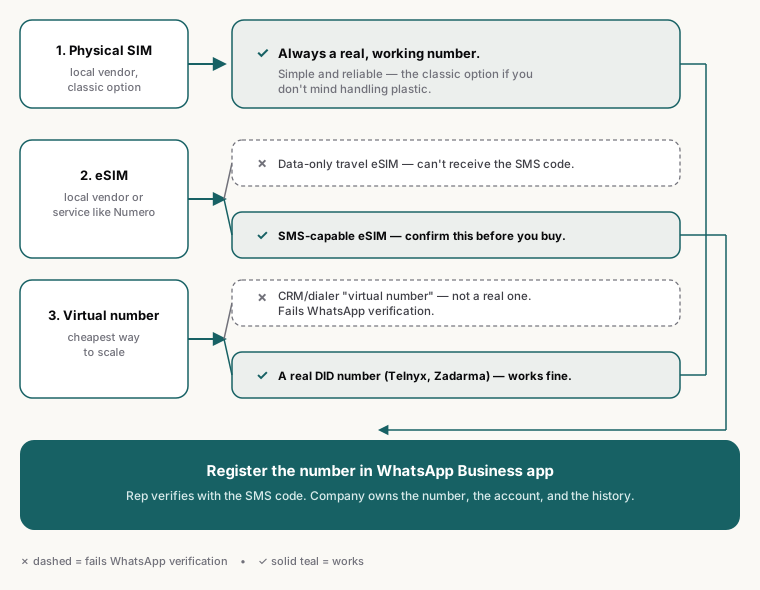
The three options
Option 1 — Physical SIM
A SIM from a local vendor. Simple and reliable — the classic option if you don't mind handling plastic. Buy it, drop it in a phone (or a SIM-swap-friendly spare), and it can receive an SMS the moment it's active, because it's a real number on a real carrier. There is no verification-risk conversation to have about a physical SIM. The tradeoff is entirely logistical: someone has to physically source it, and if you're provisioning numbers across a few countries, that means a few different local errands rather than one purchase from a dashboard.
Option 2 — eSIM
An eSIM from a local vendor, or a service like Numero. The pitch is obvious — no plastic, no courier, activate from a QR code and you're done. The catch is real and it's the one people miss: most travel eSIMs are data-only and won't work for WhatsApp registration. They're built for roaming data plans, not for receiving a text. WhatsApp verifies the number by SMS, so before you buy, confirm specifically that the eSIM plan includes SMS reception — not just "connectivity," not just data. If the provider's page only talks about gigabytes and doesn't mention texting, assume it's data-only and ask directly before you pay.
Option 3 — Virtual number
The cheapest way to scale, with one big caveat: it has to be a DID number — a real phone number that can receive SMS, issued the same way a carrier issues one, just delivered over IP instead of a physical line. The "virtual numbers" that most CRMs and dialers hand out by default are a different thing entirely — a routing extension inside their own softphone system, not a number Meta's SMS gateway can actually reach. It'll look like a number in the CRM's UI. It will not pass WhatsApp verification.
The "virtual numbers" most CRMs and diallers hand out are not actual numbers and won't pass WhatsApp verification.
Where to get a real one: larger providers like Telnyx or Zadarma, or smaller specialist vendors like YourBusinessNumber (pricier, but built specifically for this use case). Beyond that it's genuinely worth just searching for a local provider in your target country — the DID market is regional and fragmented, and a specialist local vendor sometimes has better rates and faster support than a global platform. Whichever you pick, the one question to ask before paying is blunt and specific: "Is this a DID number that can receive an SMS, or is it a softphone extension?" A vendor who sells WhatsApp-ready numbers will answer that in one sentence. A vendor who hedges is telling you something.
Practical
How do you know a number will pass before you hand it to a rep?
Don't find out during onboarding. Buy or provision the number, then register it in WhatsApp Business app yourself — or on a spare device — before it ever reaches the rep it's meant for. If the SMS code arrives, the number is real and you're done in five minutes. If it doesn't, you've lost five minutes instead of an afternoon, and you still have time to ask the provider for a refund or swap before anyone downstream is depending on that number.
Verdict
What this means for your setup
If you're setting up one or two numbers and don't mind a physical errand, buy a local SIM — there's no ambiguity to manage. If you want to skip the plastic, an eSIM works exactly as well, provided you confirm SMS support in writing before you pay, not after. If you're provisioning numbers at any real scale, a virtual/DID number from a provider that explicitly serves WhatsApp registration is the cheapest and most operationally simple path — just confirm "DID, not extension" before committing, and register one test number yourself before you roll out the rest. Whichever path you pick, this is only step one: for the fuller case on why the number should be company-owned in the first place, and what changes once it is, see Personal vs company numbers — pick company numbers, then sync. For how to actually connect that number into your CRM once you have it, see QR vs Coexistence vs WABA — pick the right transport.
Cluster hub: /perspectives/topic/operational-mechanics/.
More perspectives
Personal vs company numbers — pick company numbers, then sync
Personal numbers give you reps you cannot onboard, audit, or offboard. Six reasons to issue company numbers — WhatsApp Business on a virtual SIM — and sync those.
Cyril Zakirov
QR vs Coexistence vs WABA — pick the right WhatsApp transport for your sales stack
Three ways to connect WhatsApp to a sales tool — QR-linked devices, WhatsApp Coexistence, and the WhatsApp Business API. They are not competitors. Most teams need two of the three. Here is how to pick by use case.
Cyril Zakirov