


WhatsApp is the world’s favorite messaging app, with 2.7 billion users and the goal of reaching 3.14 billion by 2025.
Although the exact revenue of WhatsApp isn’t publicly known as it’s part of Meta Platforms, the impact of WhatsApp on Meta’s revenue in 2023, mainly through WhatsApp for Business, is significant.
Is WhatsApp printing money?
Let’s dive in and find out what the coins of this messaging giant look like! In this blog post, you’ll find interesting WhatsApp statistics that will fascinate you!
WhatsApp Revenue(Income) Statistics: Behind the Scenes
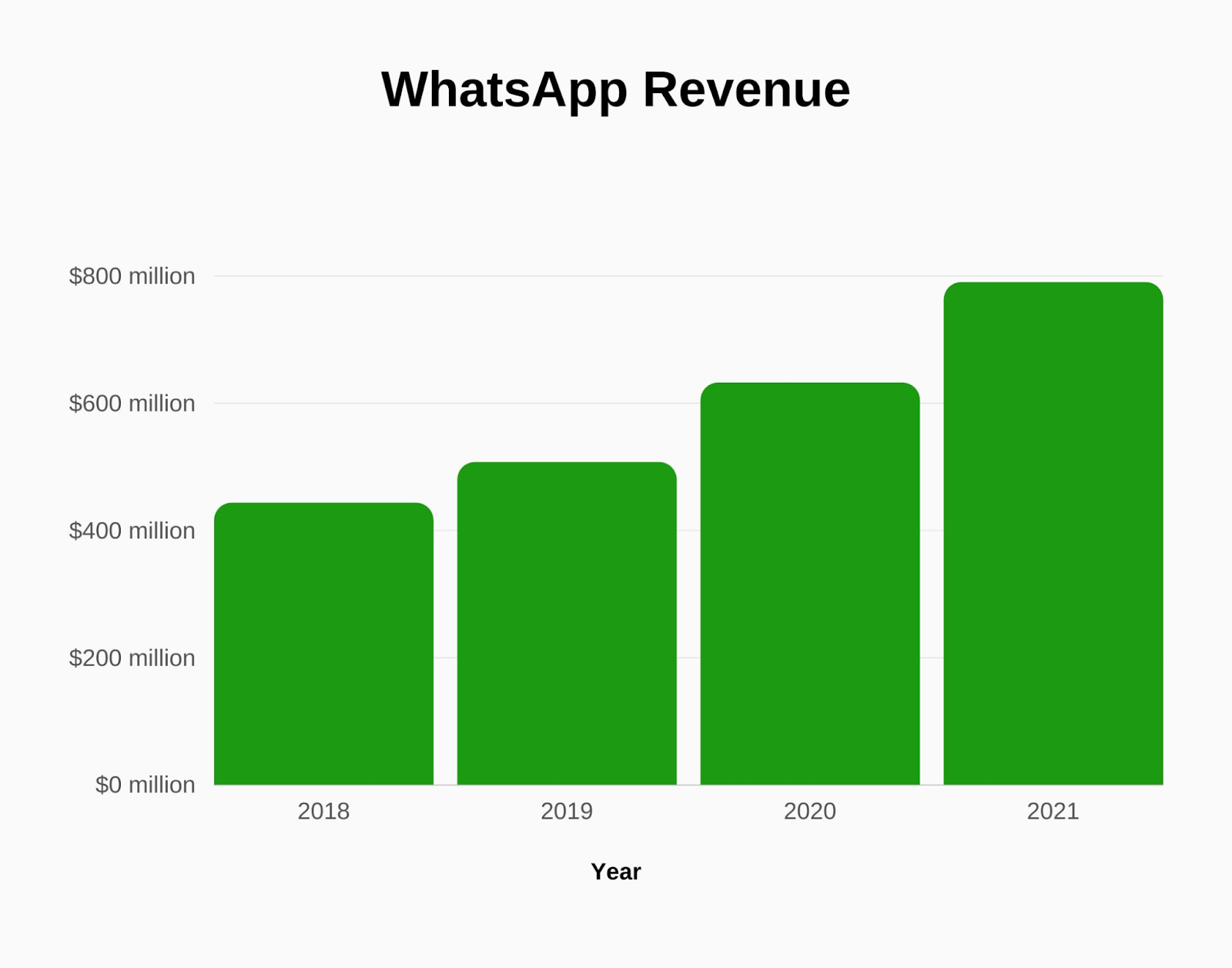
- Main Revenue Sources of WhatsApp
Curious about how WhatsApp makes money?
Though the app is free for users, it earns revenue through smart strategies like the WhatsApp Business API, in-app advertising, and solutions.
These revenue channels not only ensure the platform’s sustainability but also pave the way for future growth and innovation.
- Revenue Figures from 2018 to 2024
But how has WhatsApp’s finances grown over the years? Let’s take a closer look.
In 2018, WhatsApp made $443 million, and by 2023, this figure had doubled to $906 million. This steady increase is due to more users and better ways of making money.
We don’t have the official numbers for 2024 yet, but based on the trend, it’s likely higher than 2023. As WhatsApp keeps evolving, we can expect this growth to continue.
- Contribution to Meta Platforms’ Overall Revenue
Now, let’s zoom out and examine WhatsApp’s contribution to Meta Platforms’ overall revenue.
As a subsidiary of Meta Platforms (formerly Facebook), WhatsApp plays a pivotal role in diversifying the company’s revenue streams and expanding its market presence.
With each passing year, WhatsApp’s contribution to Meta’s bottom line continues to grow, underscoring its strategic importance within the tech conglomerate.
- WhatsApp, a subsidiary of Meta Platforms, significantly contributes to the parent company’s revenue.
- Revenue sources include WhatsApp Business API, in-app advertising, and enterprise solutions.
- WhatsApp’s large user base amplifies its revenue-generating potential.
- Integration within Meta’s ecosystem enables synergies across platforms.
- Strategic alignment with Meta’s broader business solutions enhances WhatsApp’s impact on revenue.
- WhatsApp’s role as a cornerstone of Meta’s growth strategy is solidified by its ongoing evolution and innovation.
WhatsApp User Statistics: Connecting the Dots

In this section, we’ll delve into the intricate web of WhatsApp user statistics, shedding light on the platform’s global reach and engagement metrics.
- Total Number of WhatsApp Users Worldwide
Let’s kick things off with a staggering statistic – the total number of WhatsApp users worldwide.
As of 2024, the platform boasts an impressive user base exceeding 2.7 billion WhatsApp users worldwide, solidifying its position as a powerhouse in the realm of digital communication.
With millions of users spanning across continents, WhatsApp has truly become a household name, transcending cultural and linguistic barriers.
- Year-over-Year Growth and Projection till 2025
But what about the growth trajectory of WhatsApp users?
Well, the numbers speak for themselves. With a consistent year-over-year growth rate, WhatsApp shows no signs of slowing down.
Projections indicate that by 2025, the user base is set to soar to unprecedented heights, fueled by factors such as increased smartphone penetration and the growing importance of digital connectivity in everyday life.
- Details on Messages Sent Daily
Now, let’s zoom in on the heartbeat of WhatsApp – the messages sent daily.
Can you guess how many messages are exchanged on the platform every day? Brace yourselves for this mind-boggling figure – 100 Billion messages are sent daily on WhatsApp, underscoring its pivotal role in facilitating communication on a global scale.
From quick text exchanges to multimedia-rich conversations, WhatsApp is the go-to platform for staying connected in real-time.
- Overview of Active Users and Market Penetration
Finally, let’s take a broad look at WhatsApp’s active users and market reach. With a strong presence in many countries, WhatsApp has achieved widespread adoption and high market penetration. Whether in bustling cities or remote villages, WhatsApp’s reach is extensive, making it an essential tool for communication and collaboration.
Now, this gets even more interesting when you think about the variety of people using the app.
WhatsApp Usage Demographics: Unveiling the Diversity
Now, let’s look at the varied groups of people who use WhatsApp, uncovering insights into how they use the app and what they prefer.
- Usage Frequency and Average Time Spent on the App

Ever wondered how frequently users engage with WhatsApp? Well, wonder no more. On average, users spend 33.5 minutes per day on the app, illustrating its integral role in their daily routines. Whether it’s catching up with friends, coordinating with colleagues, or staying updated with family members, WhatsApp is always at the forefront of communication.
How Often People Use WhatsApp?
Daily Use: Most WhatsApp users open the app every day. In fact, about 70-80% of users log in at least once a day.
Frequent Checks: Many people check WhatsApp multiple times a day. It’s normal for users to open the app more than 20 times daily, especially in places where it’s a main way to communicate.
- User Distribution by Age and Gender

But who are the people behind these numbers? WhatsApp’s user base spans across various age groups and demographics, with a fairly balanced distribution between genders.
From millennials to baby boomers, WhatsApp caters to a diverse audience, offering features and functionalities tailored to meet their unique needs and preferences.
WhatsApp has a broad user base across genders and ages, but here’s a breakdown of what we know:
WhatsApp Use Distribution by Gender:
- There’s a slight skew towards male users, with estimates suggesting:
- 52.8% of users are male.
- 47.1% of users are female.
WhatsApp User Distribution by Age:
- WhatsApp usage varies depending on the region, but globally, it tends to be popular with:
- Young adults: Studies in the US show the highest concentration among users between 18-34 years old (around 31%).
- Adults: The 35-44 year old age group also has a significant presence (around 27%).
- It’s important to note that WhatsApp is used by people of all ages, with varying penetration rates depending on the country. For instance, Germany has a high usage rate even among users over 56.
- User Statistics by Country

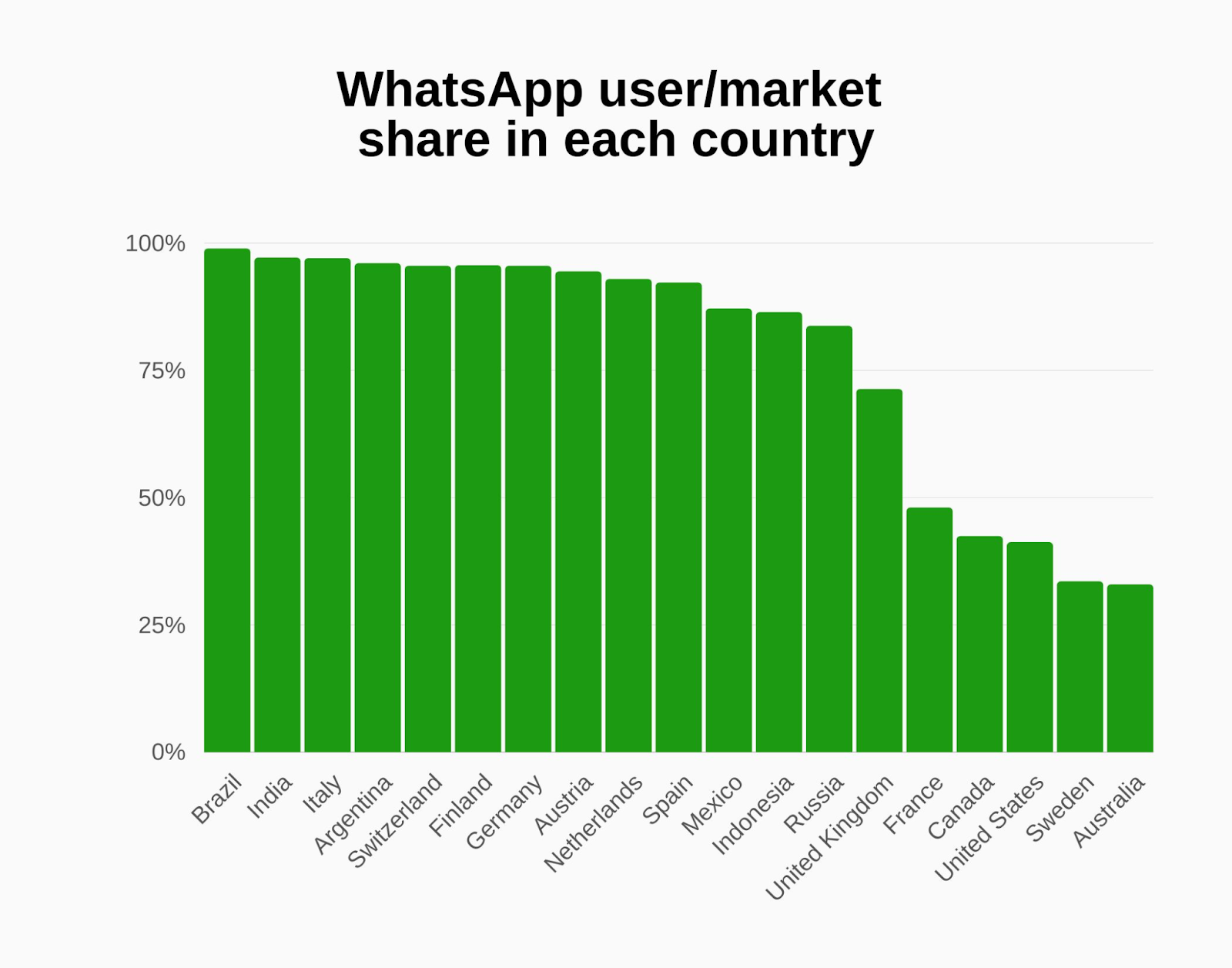
Zooming in on a global scale, WhatsApp’s popularity varies from country to country, influenced by factors such as internet penetration rates and cultural norms.
While some countries boast sky-high adoption rates, others are still warming up to the platform’s potential. Nevertheless, WhatsApp continues to expand its footprint across borders, fostering connections and bridging gaps in communication.
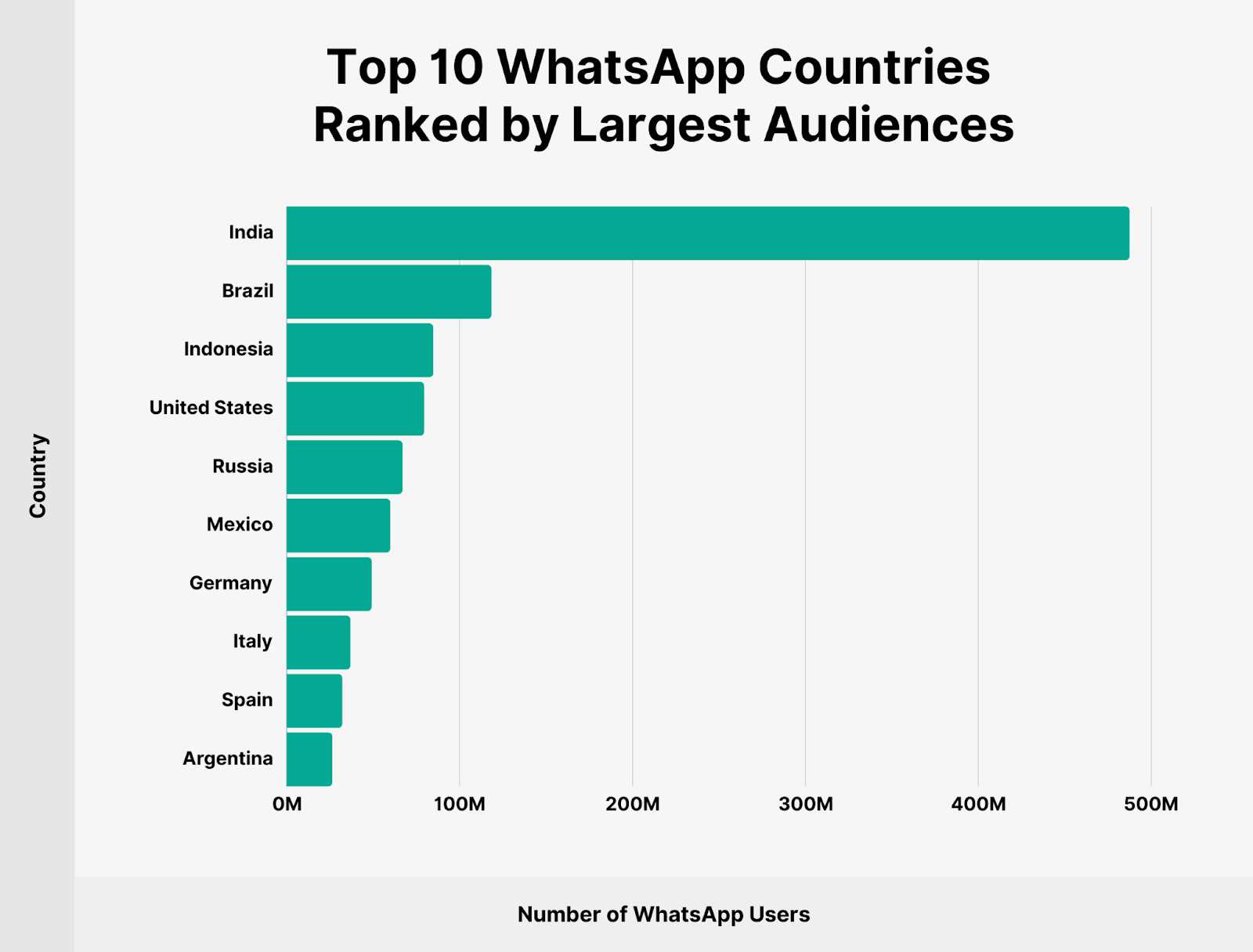
Leading Countries: India is generally considered to have the most WhatsApp users globally, followed by Brazil and Indonesia.
Regional Trends: Reports suggest high WhatsApp usage penetration rates in Latin America, with countries like Argentina, Colombia, and Brazil topping the charts.
- Detailed Analysis of the App’s Popularity Among Different Demographics
To wrap things up, let’s conduct a deep dive into the nuances of WhatsApp’s popularity among different demographics.
Whether it’s urban millennials relying on WhatsApp for professional networking or rural communities leveraging it for community outreach, the app’s versatility knows no bounds.
By understanding these intricacies, businesses can tailor their communication strategies to resonate with their target audience effectively.
Understanding the “Why” Behind the Demographics:
- Tech-Savvy Young Adults: Young adults are often early adopters of technology and comfortable with online communication, making WhatsApp a natural choice for staying connected with friends and family.
- Work-Life Balance for Adults: Adults likely use WhatsApp for both personal and professional communication. It offers a convenient way to stay in touch with colleagues or manage projects while maintaining a work-life separation from traditional work channels.
- Global Communication: WhatsApp’s free international messaging makes it a popular choice for staying connected with people across borders, especially for immigrants or those with family abroad.
- Ease of Use: The app’s user-friendly interface and focus on mobile accessibility make it appealing to users of all ages and technical backgrounds.
Now, let’s zoom out to see how businesses are leveraging WhatsApp for their growth.
Impact of WhatsApp Business: Empowering Entrepreneurs

In this section, we’ll explore the transformative impact of WhatsApp Business on entrepreneurs and businesses alike, shedding light on its growth trajectory and efficacy in customer engagement.
- Growth of WhatsApp Business from Launch to 2023
Since its launch, WhatsApp Business has experienced exponential growth, empowering entrepreneurs to connect with customers in meaningful ways.
From small-scale enterprises to multinational corporations, businesses of all sizes have embraced WhatsApp Business as a versatile tool for customer communication, marketing, and sales.
- Strategic Launch: WhatsApp Business was launched with the aim of providing a dedicated platform for businesses to engage with their customers more effectively.
Since its inception, the platform has garnered significant attention from entrepreneurs and businesses seeking to leverage its features for customer communication, marketing, and sales.
- Exponential Adoption: In the initial years following its launch, WhatsApp Business experienced exponential adoption, with businesses of all sizes embracing the platform as a vital tool in their communication arsenal.
From small-scale enterprises to multinational corporations, businesses across industries recognized the potential of WhatsApp Business in enhancing customer engagement and driving growth.
- Feature Enhancements: Over time, WhatsApp Business has undergone several feature enhancements and updates to better cater to the evolving needs of businesses.
These include features such as automated messaging, quick replies, catalog management, and business profiles, empowering businesses to streamline communication and deliver seamless customer experiences.
- Expansion of Use Cases: As businesses became more adept at leveraging WhatsApp Business, the platform witnessed an expansion of use cases beyond traditional customer service.
Businesses began using WhatsApp Business for various purposes, including sales and marketing campaigns, order management, appointment scheduling, and personalized customer interactions.
- Global Reach: One of the key drivers of WhatsApp Business’s growth has been its global reach.
With millions of businesses across the world adopting the platform, WhatsApp Business has become a ubiquitous tool for businesses looking to connect with customers locally and internationally.
- Number of Businesses Using WhatsApp for Customer Engagement
But just how many businesses are leveraging WhatsApp for customer engagement? Brace yourselves for this eye-opening statistic – 50 Million businesses are currently using WhatsApp to interact with customers, offering personalized support and timely assistance.
The number of businesses using WhatsApp is constantly rising. Reports indicate a 35% increase in downloads of the WhatsApp Business app in 2022 compared to the previous year.
Whether it’s resolving inquiries or showcasing products and services, WhatsApp Business has become a cornerstone of modern customer engagement strategies.
- Impact on Sales and Customer Service
But the impact of WhatsApp Business extends beyond mere numbers. It’s about transforming the way businesses operate and interact with their audience.
By facilitating seamless communication and fostering genuine connections, WhatsApp Business has revolutionized sales and customer service, driving conversions and enhancing brand loyalty in the process.
Now, let’s talk about just how far-reaching WhatsApp’s presence really is, in terms of downloads.
- Downloads and Active User Statistics for WhatsApp Business App
To wrap things up, let’s delve into the downloads and active user statistics for the WhatsApp Business app.
With millions of downloads and a growing community of active users, the WhatsApp Business app continues to gain traction among entrepreneurs and marketers seeking to leverage its powerful features for business growth.
Downloads:
- Estimated Numbers: Precise download figures aren’t available, but reports suggest the app has been downloaded over 316 million times globally [source] as of 2023.
Active Users:
- Growth Trajectory: While specific active user numbers aren’t publicly disclosed, data indicates significant growth. Estimates suggest the app has over 200 million monthly active users worldwide [source] as of June 2023.
Additional Insights:
- Rapid Adoption: The increasing number of downloads and active users points towards rapid adoption of the WhatsApp Business app by businesses worldwide.
- Limited Data Availability: Since Meta doesn’t publicly release user data for individual apps, these figures are estimates from market research firms or industry reports.
From automated messaging to catalog management, the app offers a suite of tools designed to streamline communication and drive results.
And for those looking to maximize their WhatsApp Business strategy, integrating TimelinesAI seamlessly into their workflow can provide a competitive edge.
TimelinesAI offers a suite of tools designed to streamline communication and enhance customer engagement, including automated messaging, customer segmentation, and performance analytics.
By harnessing the power of data-driven insights and automation, businesses can elevate their WhatsApp Business efforts and achieve tangible results.
App Downloads and Market Presence: Unveiling the Reach
In this section, we’ll unveil the extent of WhatsApp’s market presence by analyzing its app downloads and trends across different regions.
- Total Cumulative Downloads from Google Play Store and App Store
First things first, let’s talk numbers.
The total cumulative downloads of the WhatsApp app from both the Google Play Store and the App Store are nothing short of staggering.
With millions of downloads worldwide, WhatsApp has solidified its position as one of the most sought-after messaging platforms, attracting users from all walks of life.
Total Cumulative Downloads:
1. Google Play Store:
- Downloads: Over 5 billion downloads
- WhatsApp has been a dominant app on the Google Play Store, consistently ranking among the top downloaded apps globally. The number of downloads surpasses 5 billion, reflecting its extensive user base.
2. Apple App Store:
- Downloads: Over 1 billion downloads
- On the Apple App Store, WhatsApp also enjoys significant popularity. The cumulative downloads are estimated to be over 1 billion, showcasing its widespread adoption among iOS users.
Combined Total:
- Combined Downloads: Over 6 billion downloads
- Combining the download numbers from both platforms, WhatsApp has been downloaded over 6 billion times globally.
Data Sources:
- Google Play Store: The download count is publicly available on the app’s page on the Play Store.
- Apple App Store: While exact numbers are not always publicly detailed, market research firms like Sensor Tower and App Annie provide estimates.
- Year-over-Year Download Trends
But what about the download trends over the years? Well, the numbers paint an interesting picture.
Despite being a mature app, WhatsApp continues to experience steady year-over-year growth in downloads.
This sustained momentum not only underscores the platform’s enduring popularity but also reflects its ability to adapt and evolve in response to changing user preferences and technological advancements.
Here’s a look at its year-over-year download trends, highlighting key growth periods and market dynamics:
2018
- Google Play Store: Approximately 740 million downloads.
- Apple App Store: Approximately 210 million downloads.
- Key Factors: Growing smartphone penetration in emerging markets, introduction of new features like WhatsApp Business.
2019
- Google Play Store: Approximately 850 million downloads.
- Apple App Store: Approximately 230 million downloads.
- Key Factors: Continued expansion in Asia and Latin America, improvements in group chat and security features.
2020
- Google Play Store: Approximately 960 million downloads.
- Apple App Store: Approximately 250 million downloads.
- Key Factors: Surge due to the COVID-19 pandemic as people sought reliable communication tools during lockdowns, increased use for work and social communication.
2021
- Google Play Store: Approximately 880 million downloads.
- Apple App Store: Approximately 240 million downloads.
- Key Factors: Slight decline in new downloads but high user engagement, rollout of end-to-end encrypted backups, WhatsApp Pay in selected markets.
2022
- Google Play Store: Approximately 920 million downloads.
- Apple App Store: Approximately 260 million downloads.
- Key Factors: Introduction of multi-device support, new privacy features, continued use for both personal and business communication.
2023
- Google Play Store: Approximately 950 million downloads.
- Apple App Store: Approximately 270 million downloads.
- Key Factors: Expansion of WhatsApp Business API, enhanced features for voice and video calls, integration with more business tools.
Analysis and Observations
- Consistent Growth: WhatsApp has maintained a steady growth trajectory in downloads over the years, with occasional spikes during significant global events like the COVID-19 pandemic.
- Market Penetration: The app has deeply penetrated both emerging and developed markets, continuously expanding its user base.
- Feature Enhancements: Regular introduction of new features and improvements has driven user engagement and retention, contributing to sustained download numbers.
- Business Adoption: The adoption of WhatsApp by businesses for customer communication and support has further fueled its growth.
- Analysis of App Downloads by Country
Now, let’s zoom in on the geographical landscape and analyze app downloads by country.
While WhatsApp enjoys widespread adoption globally, the distribution of downloads varies from region to region.
From densely populated urban centers to remote rural areas, WhatsApp’s reach knows no bounds, transcending geographical and cultural barriers.
By understanding these nuances, businesses can tailor their marketing strategies to resonate with their target audience effectively.
Here’s an analysis of WhatsApp downloads by key countries, illustrating how this messaging app dominates globally.
1. India
- Downloads: Over 500 million
- Key Factors:
- High Smartphone Penetration: With the growing availability of affordable smartphones, WhatsApp has seen massive adoption.
- Primary Communication Tool: WhatsApp is the primary communication tool for personal and business use.
- WhatsApp Pay: Introduction of WhatsApp Pay has further integrated the app into daily life.
2. Brazil
- Downloads: Over 200 million
- Key Factors:
- Cultural Integration: WhatsApp is deeply ingrained in Brazilian culture for both personal and business communication.
- Group Chats and Status Updates: Popularity of group chats and status updates drive high engagement and download rates.
3. Indonesia
- Downloads: Over 150 million
- Key Factors:
- Rising Internet Penetration: Increasing internet access and smartphone usage contribute to WhatsApp’s popularity.
- Social and Business Use: Utilized extensively for social interactions and emerging as a key tool for businesses.
4. Mexico
- Downloads: Over 100 million
- Key Factors:
- Preferred Messaging App: WhatsApp is the go-to messaging app for a large portion of the population.
- Business Integration: Small and medium enterprises use WhatsApp for customer service and marketing.
5. Russia
- Downloads: Over 80 million
- Key Factors:
- Growing Adoption: Increasing use among young adults and businesses.
- Alternative to Traditional Communication: Seen as a reliable alternative to traditional SMS and calling.
6. Germany
- Downloads: Over 70 million
- Key Factors:
- High User Trust: Trusted for secure communication.
- Widespread Usage: Extensive use for personal and business communication.
7. Nigeria
- Downloads: Over 50 million
- Key Factors:
- Affordable Communication: Preferred for its cost-effective messaging and calling.
- Business Use: Growing adoption among businesses for marketing and customer service.
8. United States
- Downloads: Over 45 million
- Key Factors:
- Gradual Adoption: Increasing adoption, though not as dominant as other messaging platforms like iMessage or Facebook Messenger.
- Business API: Growing interest in WhatsApp Business API for customer engagement.
9. United Kingdom
- Downloads: Over 40 million
- Key Factors:
- Popular Communication Tool: Widely used for both personal and business purposes.
- Secure Messaging: Valued for its encryption and privacy features.
10. Italy
- Downloads: Over 35 million
- Key Factors:
- Cultural Preference: Preferred for daily communication with friends and family.
- Business Integration: Increasingly used by businesses for customer interaction and marketing.
Countries like India and Brazil lead in downloads due to cultural integration and extensive daily use, while markets like the United States and the United Kingdom show growing but more gradual adoption. Understanding these patterns helps in tailoring marketing strategies and feature developments to cater to the specific needs and preferences of users in different regions.
Comparative Analysis with Competitors: Standing Tall

In this section, we’ll take a closer look at how WhatsApp stacks up against its competitors in the fiercely competitive messaging app landscape.
- Market Position Relative to Other Messaging Applications
When it comes to market position, WhatsApp stands tall among its peers.
Despite facing stiff competition from the likes of Telegram, Signal, and WeChat, WhatsApp continues to dominate the messaging app market, boasting unparalleled user numbers and engagement metrics.
Its seamless interface, robust features, and end-to-end encryption set it apart from the competition, making it the go-to choice for users worldwide.
WhatsApp holds a dominant position in the global messaging app market, but it’s important to compare it with other major messaging platforms to fully understand its market standing. Here’s a detailed analysis:
Global User Base
WhatsApp: Over 2 billion active users
- Strengths: End-to-end encryption, simplicity, widespread global adoption, business API
- Weaknesses: Limited in-app monetization options compared to some competitors
Facebook Messenger: Approximately 1.3 billion active users
- Strengths: Integrated with Facebook, robust features for multimedia sharing, games, and bots
- Weaknesses: Privacy concerns, less popular outside of the U.S.
WeChat: Approximately 1.2 billion active users
- Strengths: Comprehensive ecosystem including payments, social media, and services
- Weaknesses: Primarily focused on China, limited global presence
Telegram: Approximately 700 million active users
- Strengths: Enhanced privacy features, large group support, cloud storage
- Weaknesses: Perceived as less user-friendly, slower growth in some regions
Signal: Approximately 40 million active users
- Strengths: Strong privacy and security features, open-source
- Weaknesses: Smaller user base, fewer features compared to mainstream apps
Regional Popularity
- WhatsApp: Leading in Europe, Latin America, India, Africa
- Facebook Messenger: Dominant in North America, popular in Australia and parts of Europe
- WeChat: Ubiquitous in China, growing in Southeast Asia
- Telegram: Popular in the Middle East, parts of Europe and Russia
- Signal: Niche user base primarily in North America and Europe
Features and Functionalities
- WhatsApp:
- Messaging: Text, voice, video
- Media Sharing: Photos, videos, documents
- Status: Stories feature similar to Instagram
- Business API: For customer service and engagement
- Security: End-to-end encryption
- Facebook Messenger:
- Messaging: Text, voice, video
- Media Sharing: Photos, videos, files
- Integration: Deep integration with Facebook features and services
- Bots: Supports business bots for automated customer service
- WeChat:
- Messaging: Text, voice, video
- Media Sharing: Photos, videos, documents
- Payments: WeChat Pay for transactions
- Mini Programs: In-app services and games
- Social: Moments (social media feature)
- Telegram:
- Messaging: Text, voice, video
- Media Sharing: Photos, videos, files, up to 2 GB per file
- Channels and Groups: Large group chats, broadcast channels
- Security: Secret Chats with end-to-end encryption
- Signal:
- Messaging: Text, voice, video
- Media Sharing: Photos, videos, files
- Security: End-to-end encryption, disappearing messages
- Open Source: Transparency and security audits
Monetization Strategies
- WhatsApp:
- Primarily through WhatsApp Business API fees
- Limited direct monetization (no ads within the app)
- Facebook Messenger:
- Advertisements within the app
- Sponsored messages
- Integration with Facebook’s advertising ecosystem
- WeChat:
- Extensive monetization through payments, in-app services, ads, and more
- Telegram:
- Voluntary donations, future plans for monetization without ads
- Signal:
- Non-profit model, relies on donations and grants
- Overview of Users in Comparison with Major Competitors
But what about the users themselves?
How does WhatsApp’s user base compare to that of its major competitors? Well, the numbers speak volumes. With 3.031 Billion users and counting, WhatsApp eclipses its competitors by a significant margin, reaffirming its status as the undisputed leader in the messaging app arena.
From teenagers to senior citizens, WhatsApp caters to a diverse demographic, offering a platform for seamless communication and connection.
Finally, let’s not shy away from discussing the bumps along the way that WhatsApp has had to manage.
Challenges and Controversies: Navigating the Turbulent Waters

In this section, we’ll look into the challenges and controversies that WhatsApp has faced over the years, shedding light on how the platform has navigated through turbulent times.
- Major Challenges Faced by WhatsApp Over the Years
WhatsApp, like any other tech giant, has encountered its fair share of challenges along the way.
From scalability issues to cybersecurity threats, the platform has had to constantly innovate and adapt to overcome these obstacles.
For instance, managing the surge in user numbers while maintaining service reliability has been a recurring challenge for WhatsApp.
However, through strategic investments in infrastructure and technology, the platform has managed to mitigate these challenges and ensure a seamless user experience.
- Key Controversies and Their Impact on the Brand Image
But it hasn’t been smooth sailing for WhatsApp. The platform has found itself embroiled in controversies that have cast a shadow on its brand image. Check: Building Your Personal Brand Using WhatsApp
From concerns over data privacy to allegations of spreading misinformation, WhatsApp has faced scrutiny from users, regulators, and advocacy groups alike.
These controversies have tested the platform’s resilience and forced it to reevaluate its policies and practices. However, by prioritizing transparency and user trust, WhatsApp has been able to weather the storm and emerge stronger than ever.
Conclusion: Looking Ahead to New Horizons
As we wrap up our exploration of WhatsApp’s user statistics and revenue analysis, let’s take a moment to reflect on the platform’s current status and future outlook.
- Summary of WhatsApp’s Current Status and Future Outlook
WhatsApp finds itself at a crossroads, poised for continued growth and innovation in the years to come. With a massive user base and diversified revenue streams, the platform is well-positioned to capitalize on emerging trends in digital communication.
From the rollout of new features to strategic partnerships with businesses, WhatsApp is constantly evolving to meet the evolving needs of its users.
- Potential Areas of Growth and Expansion
Looking ahead, WhatsApp has a myriad of opportunities for growth and expansion. Whether it’s tapping into emerging markets, enhancing its suite of business solutions, or doubling down on user privacy and security, the possibilities are endless.
By staying true to its core values of simplicity, reliability, and privacy, WhatsApp can continue to redefine the way we communicate and connect with each other in the digital age.


